

Poor primer design is the single most common cause of PCR failure. A primer that looks correct in sequence can fail in the lab due to weak thermodynamics, secondary structure, or non-specific binding. Running a full quality check before synthesis saves days of troubleshooting and significant reagent cost.
What Is a Primer and Why Does Design Quality Matter?
Primers are short single-stranded DNA oligonucleotides — typically 18 to 25 nucleotides in length — that define the boundaries of your PCR amplification target. Every PCR cycle depends on these two short sequences annealing precisely to opposite strands of the template to initiate DNA synthesis. When primer design fails, amplification fails with it.
A poorly designed primer can fail in multiple independent ways. It may anneal at the wrong temperature, causing early detachment from the template before synthesis completes. It may fold into a hairpin secondary structure, where part of the primer base-pairs with another region of the same molecule, competing with template annealing. It may form a dimer with the reverse primer in the pair, consuming reagent without generating product. Or it may carry a palindromic sequence that promotes self-binding and reduces the effective primer concentration in your reaction.
Many online calculators compute only Tm or GC content in isolation, without evaluating secondary structure, pair compatibility, or thermodynamic constants under your specific reaction conditions. PrimerIQ brings these checks together. It delivers a complete, multi-parameter primer quality analysis online — free, browser-based, and with no registration needed to analyse — developed specifically for academic researchers, laboratory scientists, and life science students across India and worldwide.
Switch to the tab above to run your first analysis.
Parameters That Define Primer Quality
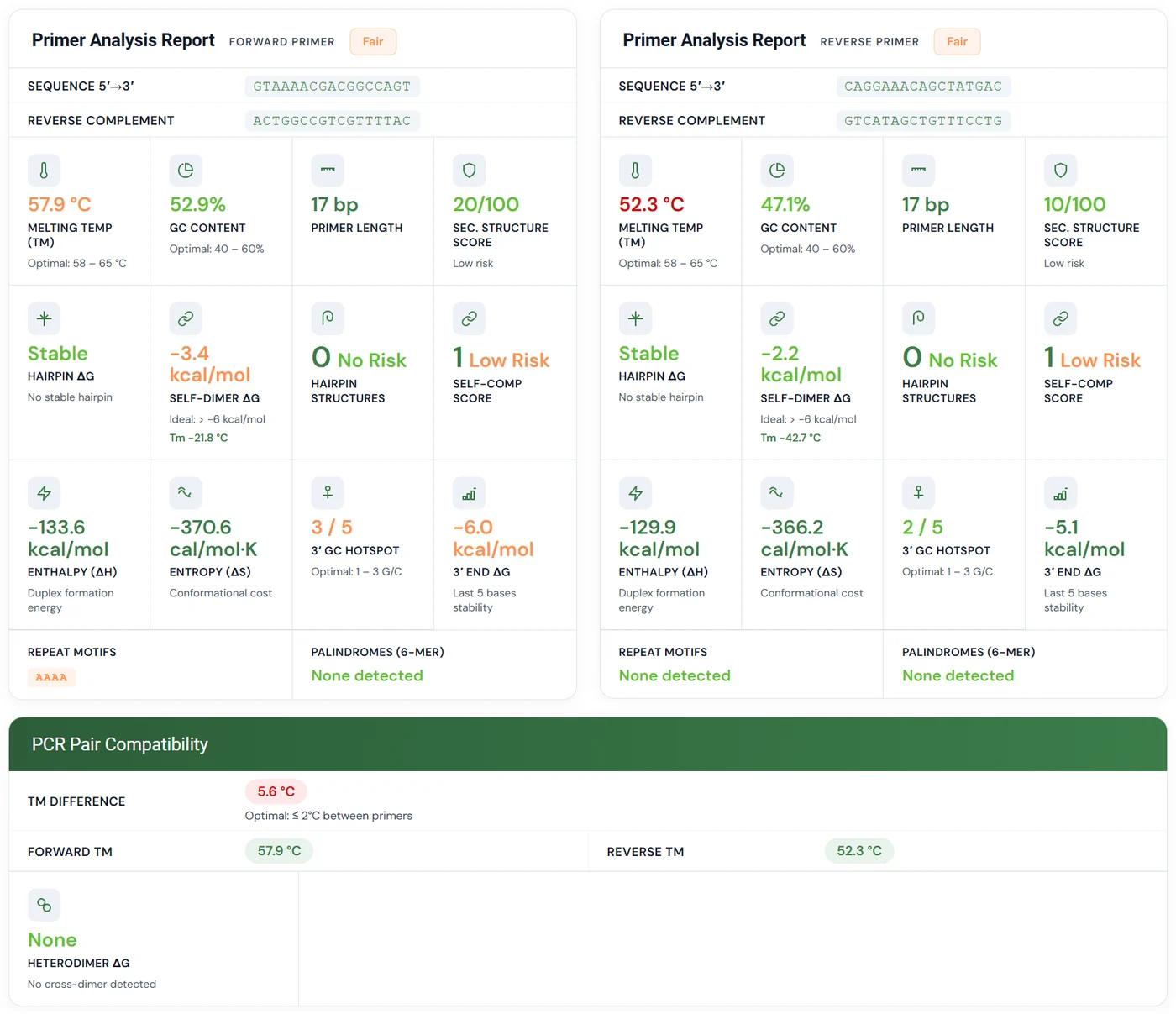
PrimerIQ evaluates eight independent quality parameters using the SantaLucia 1998 nearest-neighbour thermodynamic model, with your actual sodium and primer concentrations as inputs.
Sets your PCR annealing temperature; primer pairs should be within 2°C of each other.
Ideal: 58 – 65 °CControls binding stability: too low binds weakly, too high favours secondary structures.
Ideal: 40 – 60%Heat released on hybridisation, calculated from nearest-neighbour stacking energies.
More negative = tighter bindingDisorder cost of duplex formation; with ΔH it gives Tm under your reaction conditions.
Computed with your reaction conditionsA primer folding back on itself; a stem of just 4 bases can reduce amplification.
Ideal: None detectedA primer binding to itself or its pair, consuming primer and blocking extension.
Ideal: Score < 3GC stability at the extension start point.
Ideal: 1 – 3 G/C in last 5 basesTandem repeats cause polymerase slippage; palindromic 6-mers promote self-binding.
Ideal: None detectedReference: SantaLucia J Jr. A unified view of polymer, dumbbell, and oligonucleotide DNA nearest-neighbor thermodynamics. Proc Natl Acad Sci USA 1998;95(4):1460–1465. doi:10.1073/pnas.95.4.1460
Read the full guide: How to Check PCR Primer Quality
Advanced Analysis Capabilities
Beyond scoring individual parameters, PrimerIQ offers structural visualizations of hairpins and primer dimers.
Single Primer and Primer Pair Analysis
PrimerIQ supports two modes. In Single Primer mode it delivers a complete thermodynamic and structural quality report for one oligonucleotide — Tm, GC content, ΔH, ΔS, hairpin risk, self-dimer score, 3′ hotspot, repeats and palindromes. Switch to Primer Pair mode and PrimerIQ analyses both the forward and reverse primer independently, then evaluates their compatibility — reporting Tm difference, flagging imbalances that prevent co-amplification, and predicting every cross-dimer interaction between the two sequences.
Hairpin and Secondary Structure Visualization
When PrimerIQ detects a hairpin, it does not just flag a risk score. It renders the fold-back structure with the stem nucleotides highlighted directly within the primer sequence — showing you exactly which bases are driving the problem and where the loop forms. Researchers can instantly see what to change instead of interpreting abstract scores.
Primer Dimer Structural Visualization (Pair Mode)
In primer pair mode, PrimerIQ generates a nucleotide-level alignment diagram of predicted cross-dimer interactions between the forward and reverse primers. The visualization displays the exact overlapping bases, the positions of complementary pairing, and whether the critical 3′ end is involved in the interaction. A 3′-end cross-dimer is the most damaging type — it can be extended by DNA polymerase, rapidly depleting both primer pools.
Frequently Asked Questions
What is PrimerIQ?
PrimerIQ is a free PCR primer analysis tool that calculates melting temperature (Tm), GC content, secondary structure risk, hairpin and dimer stability, and pair compatibility using the SantaLucia 1998 nearest-neighbour thermodynamic model.
How is melting temperature (Tm) calculated?
PrimerIQ uses the SantaLucia 1998 nearest-neighbour model with full salt correction including Na+, Mg2+, and dNTP effects, plus DMSO and formamide adjustments to calculate Tm under your actual reaction conditions.
What is a good GC content for PCR primers?
The optimal GC content for PCR primers is 40-60%. Primers below 40% bind weakly leading to non-specific amplification, while above 60% the duplex becomes over-stable and secondary structures become more likely.
Can PrimerIQ analyze primer pairs?
Yes, PrimerIQ supports both single primer and primer pair analysis. In pair mode, it evaluates Tm difference, heterodimer formation risk, and cross-dimer stability between forward and reverse primers.
Does PrimerIQ support degenerate (IUPAC) primers?
Yes. PrimerIQ accepts all standard IUPAC degenerate bases (R, Y, S, W, K, M, B, D, H, V, N) in both single primer and primer pair mode. It enumerates every possible A/T/G/C variant in the pool, reports the Tm and GC% range, flags the worst-case hairpin and self-dimer risk, and warns when a degenerate base falls within the 3′ end where mismatches most affect polymerase extension.
How does PrimerIQ calculate Tm for a degenerate primer pool?
PrimerIQ expands a degenerate primer into every concrete sequence it represents (up to 256 variants) and calculates each one using the same validated SantaLucia nearest-neighbour model used for standard primers, then reports the minimum, maximum, and mean ± standard deviation Tm across the pool. For larger pools it uses a weakest/strongest-pairing bounding estimate instead of a hard limit.
Is PrimerIQ a primer dimer tool?
Yes. PrimerIQ is a free primer analyzer that includes a dedicated primer dimer tool — it scores self-dimer and heterodimer free energy (ΔG) for every primer and primer pair, flags 3′-end cross-dimers that can be extended by polymerase, and visualizes the exact nucleotide alignment driving the interaction.
How do I calculate primer melting temperature (Tm)?
PrimerIQ works as a Tm calculator: enter your primer sequence and reaction conditions (sodium, magnesium, dNTP and primer concentration, DMSO and formamide) and it calculates Tm in °C with the SantaLucia 1998 nearest-neighbour model.
What is a primer dimer, and how do I check for one?
A primer dimer forms when primers bind to each other instead of the template. PrimerIQ scores self-dimer and heterodimer free energy (ΔG) for every primer and primer pair, flags 3′-end cross-dimers that polymerase can extend, and shows the nucleotide alignment behind the interaction.
What is a hairpin in a primer, and how does PrimerIQ detect it?
A hairpin forms when part of a primer folds back and pairs with another part of itself, competing with template binding. PrimerIQ reports the hairpin ΔG and Tm and shows the fold-back structure with the stem bases highlighted.
What is the SantaLucia 1998 model?
It is a nearest-neighbour thermodynamic model that predicts DNA duplex stability from the energies of each pair of neighbouring bases. PrimerIQ uses it with your actual salt and primer concentrations.
Learn more
How to Check PCR Primer Quality: A Guide to Preventing Reaction Failure | More PrimerIQ guides
Why PrimerIQ?
PrimerIQ is built by ClariSeq Analytics in India — free, browser-based, with nothing to download and no registration needed to analyse. Sign in to save your analyses and download reports.
Every calculation runs your actual sodium and primer concentrations through the SantaLucia 1998 nearest-neighbour model. Results reflect your real reaction conditions, not a textbook average.
Unlike generic Tm calculators, PrimerIQ scores all eight quality parameters simultaneously and generates plain-language guidance — not just numbers, but specific recommendations on exactly what to fix and why.